Demon Records
John Lee Hooker - The Detroit Lion (LP, Comp, RM) (Very Good Plus (VG+))
John Lee Hooker - The Detroit Lion (LP, Comp, RM) (Very Good Plus (VG+))
Couldn't load pickup availability
Media Condition: Very Good Plus (VG+)
Sleeve Condition: Very Good Plus (VG+)
Country: UK
Released: 1990
Genre: Rock, Blues
Style: Blues Rock
Comments:
Vinyl is a conservative VG+ with light marks which do not affect play. Cover in great shape. Clean copy!
Notes:
His vintage classics, digitally remastered from source
Original 1948-1961 Recordings

Textes from back cover:

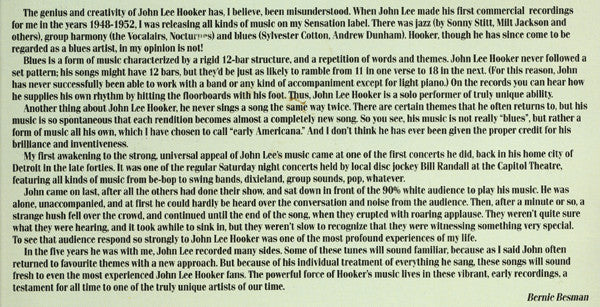
The genius and creativity of John Lee Hooker has, I believe been misunderstood. When John Lee made his first commercial recordings for me in the years 1948 - 1952, I was releasing all kinds of music on my Sensation label. There was jazz (by Sonny Stitt, Milt Jackson and others), group harmony (the Vocalairs, Nocturnes) and blues (Sylvester Cotton, Andrew Dunham). Hooker, though he has since come to be regarded as a blues artist, in my opinion is not!
Blues is a form of music characterized by a rigid 12-bar structure, and a repetition of words and themes. John Lee Hooker never followed a set pattern; his songs might have 12 bars, but they'd be just as likely to ramble from 11 in one verse to 18 in the next. (For this reason, John has never successfully been able to work with a band or any kind of accompaniment except for light piano). On the records you can hear how he supplies his hown rhythm by hitting the floorboards with his foot. Thus John Lee Hooker is a solo performer of truly unique ability.
Another thing about John Lee Hooker, he never sings a song the same way twice. There are certain themes that he often returns to, but his music is so spontaneous that each rendition becomes almost a completely new song. So you see, his music is not really "blues", but rather a form of music all his own, which I have chosen to call "early Americana." And I don't think he has ever been given the proper credit for his brilliance and inventiveness.
My first awakening to the strong, universal appeal of John Lee's music came at one of the first concerts he did, back in his home city of Detroit in the late forties. It was one of the regular Saturday night concerts held by local disc jockey Bill Randall at the Capitol Theatre, featuring all kinds of music from be-bop to swing bands, dixieland, group sounds, pop, whatever.
John came on last, after all the others had done their show, and sat down in front of the 90% white audience to play his music. He was alone, unaccompanied, and at first he could hardly be heard over the conversation and noise from the audience. Then, after a minute or so, a strange hush fell over the crowd, and continued until the end of the song, when they erupted with roaring applause. They weren't quite sure what they were hearing, and it took awhile to sink in, but they weren't slow to recognize that they were witnessing something very special. To see that audience respond so strongly to John Lee Hooker was one of the most profound experience of my life.
In the five years he was with me, John Lee recorded many sides. Some of these tunes will sound familiar, because as I said John often returned to favourite themes with a new approach. But because of his individual treatment of everything he sang, these songs will sound fresh to even the most experienced John Lee Hooker fans. The powerful force of Hooker's music lives in these vibrant, early recordings, a testament for all time to one of the truly unique artists of our time.

- Bernie Besman

The story begins late in 1948, when a little known blues singer was brought to the Detroit offices of Bernard Besman, owner of Pan American Record Distributors and Sensation Records. His name was John Lee Hooker, and he had a 78 RPM acetate disc that he had cut in one of the "Make Your Own Record" booths that were popular in the 1940's, Besman, who had already recorded blues artists like Doc Wiley, Kitty Stevenson and Don Juan Brown, wasn't very impressed with the sample, but he felt, that with some guidance, there was potential. He decided to invite Hooker to a recording session that he was doing with Todd Rhodes, one of his discoveries, who was turning out hit records.
When the session was over, Besman asked Hooker if he would like to make a test record. That test was exciting enough to bring Hooker back to cut a commercial record. That first session, with Hooker playing an acoustic guitar, began a career that is now entertaining almost three generations of music lovers.
Bernie Besman knew, after listening to that first session, that John Lee Hooker was a unique artist. He wasn't locked into a 12 bar blues pattern, or the repetitions that were often associated with the blues. Even his retakes were original!
The results of that session were released on Sensation Records, but because of limited distribution the masters were leased to Modern Records in Los Angeles. Modern specialized in the R&B market, and they did their own pressing, as well as handling distribution throughout the United States. That first release, "Boogie Chillen" was a hit, and the public wanted to hear more of John Lee Hooker.
Hit followed hit, and over a four year period, Besman produced over 200 sides of what most consider to be, "the best of John Lee Hooker". These sessions were a hearth of creativity, both for the artist, and especially for Besman, who experimented with microphone placement (you can hear Hooker's foot keeping time because of a microphone placed under a wooden platform) and "special effects", such as placing a microphone in a toilet to get a full echo sound.
The music you are hearing is pure originality. Most of it was written by Hooker, with help and inspiration of Bernie Besman. The man you hear is John Lee Hooker, his guitar, and some occasional help from friends like Sylvester Cotton (guitar), Andrew Dunham (guitar), Eddie Burns (guitar and harmonica), and Bernie Besman (piano and organ).
Now it's time to listen to the music that rock artists like Canned Heat, the Doors, the Animals, George Thorogood and countless others have cut their musical teeth on. Here is the greatness of John Lee Hooker and his music.

- Darryl Stolper

℗ 1989 Besman Record Productions
©  1990 Demon Records Ltd.
Made in England
A1. Hey, 'S The House Rent Boogie! 3:00
A2. I'm In The Mood 2:55
A3. Baby How Can You Do It? 2:44
A4. Let's Talk It Over 2:59
A5. Yes, Baby, Baby, Baby 2:38
A6. I Got The Key 2:43
A7. Four Women In My Life 3:02
A8. Do My Baby Think Of Me? 2:52
B1. I'm Gonna Git Me A Woman 2:31
B2. It Hurts Me So 2:46
B3. Bluebird, Bluebird, Take A Letter Down South 2:43
B4. Boogie Chillen 3:09
B5. Hello Baby 3:15
B6. This Is 19 And 52, Babe 3:09
B7. Blues For Abraham Lincoln 3:03
Barcode and Other Identifiers:
Barcode 5 014757 031540
Matrix / Runout FIEND 154/A
Matrix / Runout FIEND 154/B
Matrix / Runout MPO FIEND 154 A1 A PORKY PRIME CUT.
Matrix / Runout MPO FIEND 154 B1 A PORKY PRIME CUT.
Record Company Demon Records Ltd.
Phonographic Copyright (p) Besman Record Productions
Copyright (c) Demon Records
Recorded At United Sound Systems
Pressed By MPO
Share